
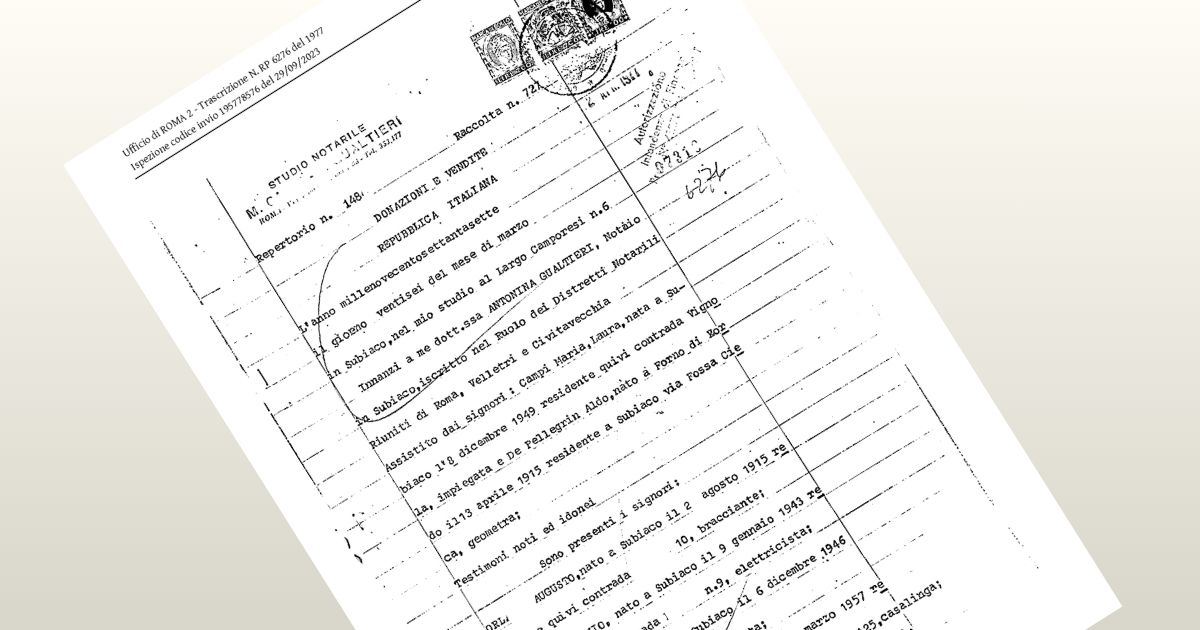
The legal cornerstone of a secure property purchase, especially for international buyers
Buying property in Italy is never a simple agreement between a buyer and a seller.
It is a legally structured act, governed by a rigorous system rooted in tradition, legal certainty and individual responsibility.
At the heart of this system stands a key figure: the Italian notary (notaio).
For Italian buyers, the notary’s role is often taken for granted.
For international buyers, however, the notary becomes a fundamental reference point — sometimes the only true legal anchor in an unfamiliar environment.
Understanding the role of the notary in Italy is essential to approach a property purchase with clarity, structure and peace of mind.
In Italy, a notary is a public official responsible for ensuring the legal validity of a property purchase.
The notary verifies the legal status of the property, drafts and authenticates the deed of sale, collects taxes and registers the transfer of ownership.
Notarial intervention is mandatory for any real estate transaction in Italy.
The Italian notary: a pillar of the property system
The Italian notary is a public officer appointed by the State, bound by strict duties of neutrality and independence.
They do not represent either the buyer or the seller. Their role is different: to protect the legal validity of the transaction and ensure compliance with the law.
The notary’s involvement gives the deed of sale full legal authenticity, enforceability against third parties and long-term legal certainty.
This authenticity is what ultimately guarantees full ownership of the property.
Without a notary, no property transfer is legally valid in Italy
A role that begins well before the day of signature
Contrary to common belief, the notary’s work does not begin and end on the day of signing.
It is part of a broader process, often invisible to the buyer, yet decisive for the legal solidity of the transaction.
Before any signature, the notary verifies that the seller is the legitimate owner of the property, that the property is free of mortgages or legal disputes, and that its cadastral and urban planning status is compliant.
These checks may appear technical.
In reality, they form the foundation of legal security in an Italian property purchase.
Drafting and authentication of legal documents
The notary is responsible for drafting and authenticating the legal acts.
They may intervene as early as the preliminary agreement (contratto preliminare), when notarised, and later at the final deed of sale (atto di compravendita).
Each clause is carefully reviewed to ensure it is legally valid, compliant with Italian law and fully understood by all parties.
The objective is not merely to sign, but to sign with full legal awareness.
Calculation and collection of taxes
The notary also plays a central fiscal role.
They calculate, collect and remit, on behalf of the State, the registration tax, mortgage tax and cadastral tax.
For international buyers, this centralised process is reassuring:
it reduces the risk of errors, omissions or unexpected issues after completion.
The notary’s role for international buyers
When the buyer is not an Italian resident, the notary’s role becomes even more structuring.
The notary ensures that the buyer fully understands the legal implications of the purchase, their rights and obligations, as well as the fiscal and patrimonial consequences of the transaction.
When the Italian language is not mastered, the involvement of a certified interpreter ensures that every clause is explained, understood and accepted transparently.
This requirement protects both the buyer and the legal validity of the deed.
Additional services that may facilitate a remote purchase
Beyond their legal obligations, some notaries may offer — or coordinate — additional services that are particularly useful in an international context.
In certain cases, they may assist with the application for an Italian tax code (codice fiscale), which is mandatory to purchase property, or oversee a purchase completed through a power of attorney (procura notarile) when the buyer cannot be physically present in Italy.
These solutions are entirely lawful but require precise legal drafting and careful anticipation.
They reflect the Italian system’s ability to adapt, without ever compromising legal security.
After completion: legal formalities and administrative follow-up
Once the deed is signed, the notary proceeds with the official registration, land registry transcription, cadastral updates and preservation of the authenticated deed
These steps are an integral part of the notary’s legal duties.
In an international context, some notaries also provide enhanced follow-up, facilitating certified copies or explaining post-purchase formalities at a distance.
The difference lies not in the law itself, but in the level of support offered.
How much does a notary cost in Italy?
Notary fees in Italy are not fixed.
They depend mainly on the property value, the complexity of the transaction and the scope of legal checks required.
As a general indication, for a standard residential purchase, notary fees typically range between 1% and 2.5% of the purchase price, with a minimum often between €1,500 and €2,000.
Taxes are separate and may represent a significant part of the overall acquisition cost.
A notary always provides a detailed quotation in advance, ensuring transparency.
Conclusion – The notary as the guarantor of a coherent property project
The Italian notary is the guardian of legal security in any real estate transaction.
Their role, deeply rooted in legal tradition, protects buyers over the long term — particularly in international projects.
Understanding the role of the notary in Italy means laying the foundations for a property purchase that is coherent, secure and sustainable.
In cross-border real estate, trust is never improvised.
It is built through anticipation, legal rigour and respect for the Italian legal framework.