
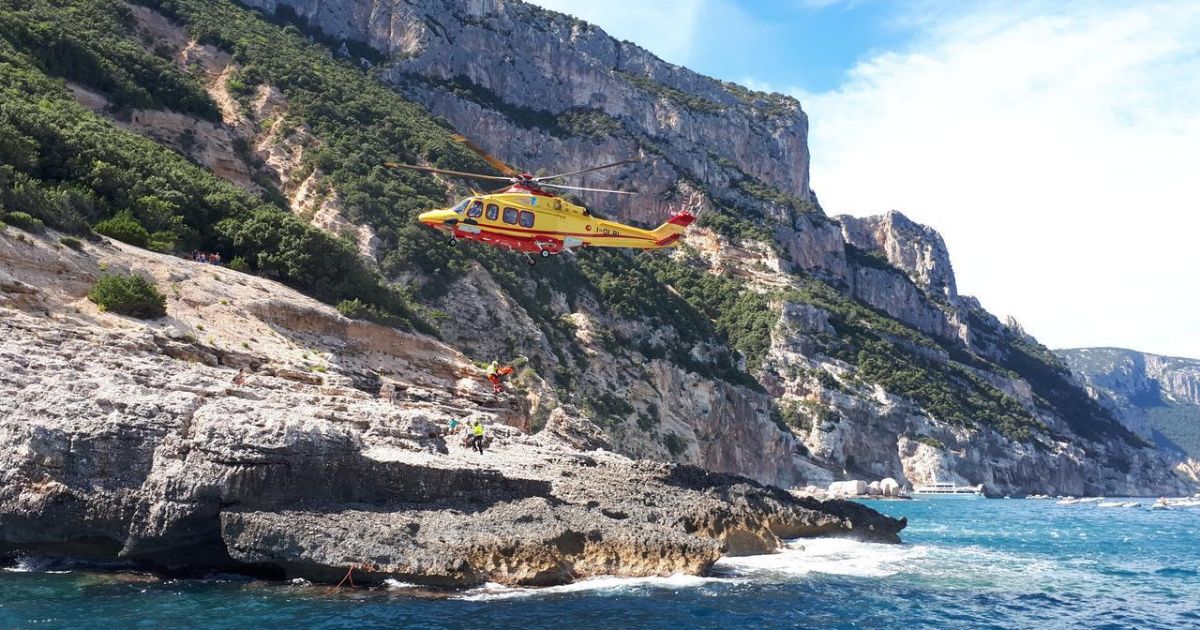
Beyond the distance to the nearest hospital: understanding helicopter emergency medical services in Sardinia
On 16 August 2026, Yael Trepy, a young forward for Cagliari Football Club, was involved in a serious accident in the swimming pool of a villa in Porto Cervo. He nearly drowned and required emergency medical care.
Following the intervention of the 118 emergency service, he was airlifted to the Santissima Annunziata Hospital in Sassari, where he was admitted to intensive care. The incident naturally attracted considerable media attention, both because of the seriousness of his condition and because he is a professional footballer.
But beyond the news story, the accident raises a question that is rarely considered when thinking about living in Sardinia or buying a home on the island: How far are you really from emergency care when a serious medical emergency occurs?
How are medical emergencies in Sardinia handled when distance becomes a critical factor?
The answer is more complex than a simple calculation on Google Maps.
A hospital 60 kilometres away is only part of the equation
When assessing a property, certain distances are almost always considered: the airport, the beach, shops, restaurants and sometimes schools.
Distance to the nearest hospital may also be part of the equation, particularly when a property is intended to be occupied for much of the year.
But knowing where the nearest hospital is does not, on its own, tell you how effectively a serious medical emergency can be managed.
In the event of a serious accident, heart attack, stroke or major trauma, when every minute matters, the priority is not necessarily to reach the geographically closest hospital, but to reach, as quickly as possible, the facility with the appropriate specialist capabilities.
This is precisely one of the functions of Sardinia’s pre-hospital emergency network.
Three helicopters covering Sardinia
The elisoccorso service — Sardinia’s Helicopter Emergency Medical Service, or HEMS — is managed by AREUS, the regional authority responsible for emergency and urgent medical care.
It complements the ground ambulance network and forms an integral part of the island’s public emergency healthcare system.
Three helicopters are currently dedicated to the service, operating from bases in Olbia, Alghero-Fertilia and Cagliari-Elmas.
The aircraft based in Alghero and Cagliari operate during daylight hours. The Olbia-based AW139 operates 24 hours a day, including at night.
The helicopters are dispatched by the 118 emergency coordination centres in Sassari and Cagliari and can operate throughout Sardinia.
One of the main objectives of the service is to reduce transport times and enable critically ill or injured patients to reach appropriate medical care as quickly as possible, particularly in time-sensitive emergencies.
AREUS specifically identifies heart attacks, strokes and major trauma among these situations. It also highlights the role of helicopter emergency services in improving access to care for people in isolated areas or places where travelling by road would require significant time.
In other words, helicopters do not eliminate the geographical challenges of a large and relatively sparsely populated island.
They are one of the ways Sardinia addresses them.
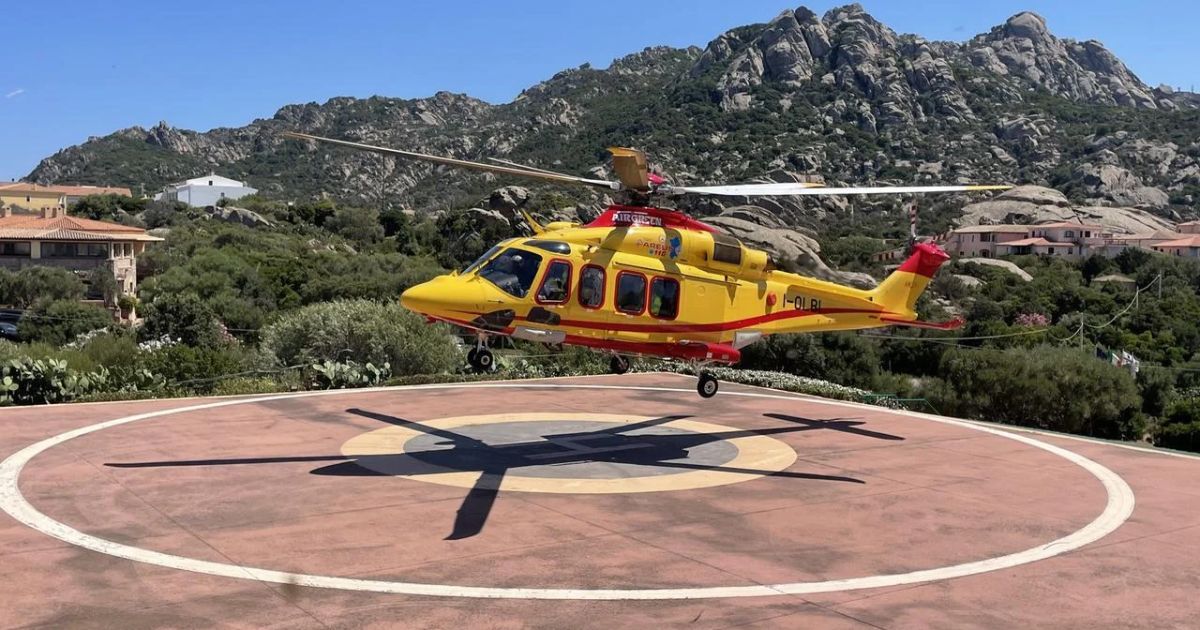
Porto Cervo attracts attention. But the service is not reserved for Porto Cervo.
Yael Trepy’s accident could easily create a misleading impression. A villa in Porto Cervo. The Costa Smeralda. A professional footballer. An emergency helicopter transfer. It could almost appear to be an exceptional service.
It is not.
The elisoccorso is part of Sardinia’s public emergency healthcare system. Its deployment depends on the patient’s medical condition and operational requirements, not on the patient’s social or financial status.
One could also point out that private medical care is available locally in Porto Cervo.
That is true.
The Consorzio Costa Smeralda has operated its own Servizi Medici for more than forty years. The private facility is open to everyone and provides a local medical service comparable to an advanced out-of-hours medical centre. Its services include general and specialist consultations, X-rays, ultrasound examinations and other diagnostic services, as well as an ambulance service during the summer season.
This is an important local healthcare resource. But having medical care nearby and having access to the level of care required for a life-threatening emergency are two different things.
Yael Trepy’s case illustrates the distinction. Faced with a critical situation, the public emergency response chain was activated, from the intervention of the 118 service through to his transfer by helicopter to Santissima Annunziata Hospital in Sassari.
The presence of a medical facility nearby is therefore an important consideration when assessing a place to live, but it does not, on its own, tell us how a serious emergency will be managed.
This is where understanding the wider network — ground emergency services, 118, helicopter rescue and hospitals — becomes relevant.
I saw a much more personal example of this during the summer.
In July, a member of my extended family required urgent medical assistance in Castelsardo. A helicopter was dispatched and landed in the harbour area, allowing the patient to be transferred for further care.
This time it was Castelsardo, far removed from the highly publicised context of Porto Cervo, but the principle was the same: a medical emergency and a public emergency service deployed when it was needed.
The experience made me look differently at an infrastructure whose existence we may be aware of, but rarely think about until we actually need it.
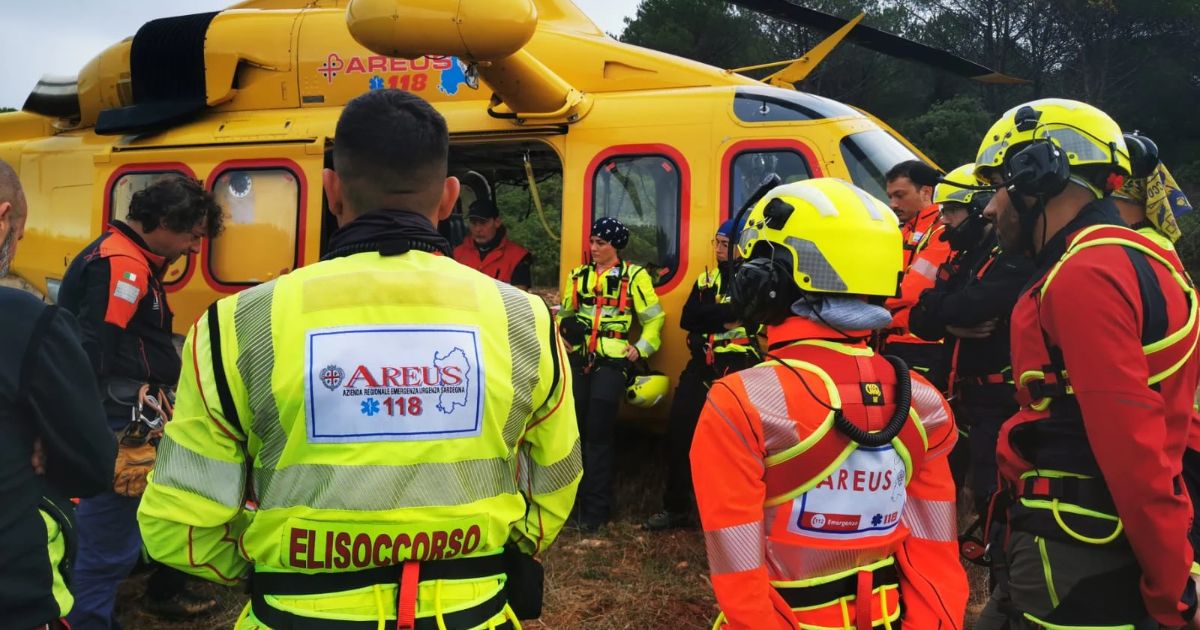
A network extending well beyond its three helicopter bases
The system is considerably more extensive than the existence of three helicopter bases might suggest.
In October 2025, AREUS announced the development of a network of 92 landing sites, comprising hospital helipads and operational HEMS sites with H12 or H24 capabilities. Thirty were already operational at that time.
The objective is to extend the operational reach of the helicopter emergency service, improve the response to primary emergency missions and facilitate urgent transfers between hospitals.
This distinction matters.
Looking at Sardinia on a map, some areas may appear a considerable distance from the island’s major hospitals. In reality, access to emergency care depends on a combination of resources: the road network, ambulances, medical and nursing teams, landing sites, helicopters and, ultimately, the hospital equipped to treat the specific condition involved.
The medical geography of a territory is therefore not quite the same as its road geography.
An island whose population changes dramatically in summer
There is another factor to consider: seasonality.
During the summer, some parts of Sardinia accommodate populations significantly larger than their usual number of permanent residents. The emergency healthcare system therefore has to respond to demand that varies considerably throughout the year.
For summer 2026, AREUS strengthened its pre-hospital emergency services in several tourist areas, including Santa Teresa Gallura and San Teodoro, where advanced nursing units operate 24 hours a day.
These ground-based resources complement the helicopter emergency service operating from Olbia, Alghero and Cagliari.
This seasonal adjustment is important when trying to understand the reality of a tourist destination: a municipality’s official resident population does not necessarily tell us how many people are actually there in August.
A network that still has disparities — and continues to evolve
It would nevertheless be wrong to conclude that helicopter emergency services eliminate all the challenges surrounding access to healthcare in Sardinia.
AREUS’s own planning documents acknowledge territorial disparities in access to care. This is precisely one of the reasons why the helicopter emergency network continues to be strengthened.
An important step was taken during summer 2026.
On 6 August 2026, through Resolution No. 287, AREUS commissioned the technical and economic feasibility design for a future HEMS base in Sorgono, which is intended to become Sardinia’s fourth helicopter emergency base. AREUS now has 30 months to make the new base operational.
This development forms part of the new regional helicopter emergency service contract for 2027–2035, awarded to Airgreen and due to take effect on 1 January 2027.
Ultimately, the service will therefore operate from four bases: Olbia, Alghero, Cagliari and Sorgono.
The future Sorgono base is intended to address a specific challenge: improving coverage of Sardinia’s inland areas and reducing response times in territories that are currently furthest from the existing bases.
The point is neither to portray the system as perfect nor to suggest that geographical distance is an insurmountable problem.
It is to understand how the territory responds to that constraint — and how that response continues to evolve.
Buying a home also means understanding what surrounds it
All of this may seem far removed from a property search.
In reality, it becomes an integral part of the analysis when buying a home is part of a broader lifestyle project.
A property cannot be assessed solely within its cadastral boundaries.
A home may offer exceptional views, several hectares of land and complete privacy. These are genuine assets. But they may also come with greater distance from essential services.
How important that distance is depends on the project.
A holiday home occupied for only a few weeks each year does not necessarily raise the same questions as a property where someone intends to spend eight or ten months a year. A family with young children, a couple planning to settle permanently on the island or owners considering spending their retirement there may each assess proximity to services and the organisation of emergency care differently.
This is not an argument against isolated properties. Quite the opposite: space, nature and privacy are among Sardinia’s most sought-after qualities.
It is simply a matter of understanding what you are choosing.
Understanding a territory before buying a home there means knowing its qualities, but also its constraints and the infrastructure in place to address them.
The beach, the airport, shops and restaurants naturally form part of that assessment.
So do the services we hope we will never need.
Image credits/sources: AREUS – Azienda Regionale dell’Emergenza e Urgenza della Sardegna; La Nuova Sardegna. All rights belong to their respective owners.