
Before choosing your home, look at where the vines grow
Sardinia has been producing wine for more than three thousand years. Archaeological evidence suggests that the Nuragic people — the island’s indigenous civilisation — were already cultivating vines and practising winemaking at the end of the Bronze Age, well before the arrival of the Romans and most likely before the Phoenicians settled here. That unbroken thread connecting the island’s earliest inhabitants to its present-day vineyards is a reminder that wine in Sardinia is not simply an agricultural product. It is part of the territory’s own history.
I was born here. I grew up with this as ordinary background — vines along the roadsides, village cantine, unlabelled bottles on family tables. It was only after living abroad, and returning to Sardinia regularly, that I came to understand how much this wine culture says about the island — something that even the best travel guides rarely convey.
What deserves attention is not the wine itself, but the territories where these vines have taken root, sometimes over centuries, and what their presence still reveals today. Sardinian vineyards are not simply a farming activity. They tell the story of regional differences, climatic constraints, the habits of local communities, and the ways in which Sardinians have learned to inhabit their environment over time.
For someone coming from outside who is considering life in Sardinia, understanding where the vines grow often means understanding something deeper: why certain areas have developed a distinct identity, why the landscape shifts from one valley to the next, and why two villages a few dozen kilometres apart can offer radically different ways of living.
Sardinian wines become, in this sense, a way into understanding the island.
Grape varieties as a reflection of their territories
Sardinia holds one of the most singular viticultural heritages in the Mediterranean. Much of its production rests on grape varieties that have found their own expression here — one that is often very different from what is observed elsewhere.
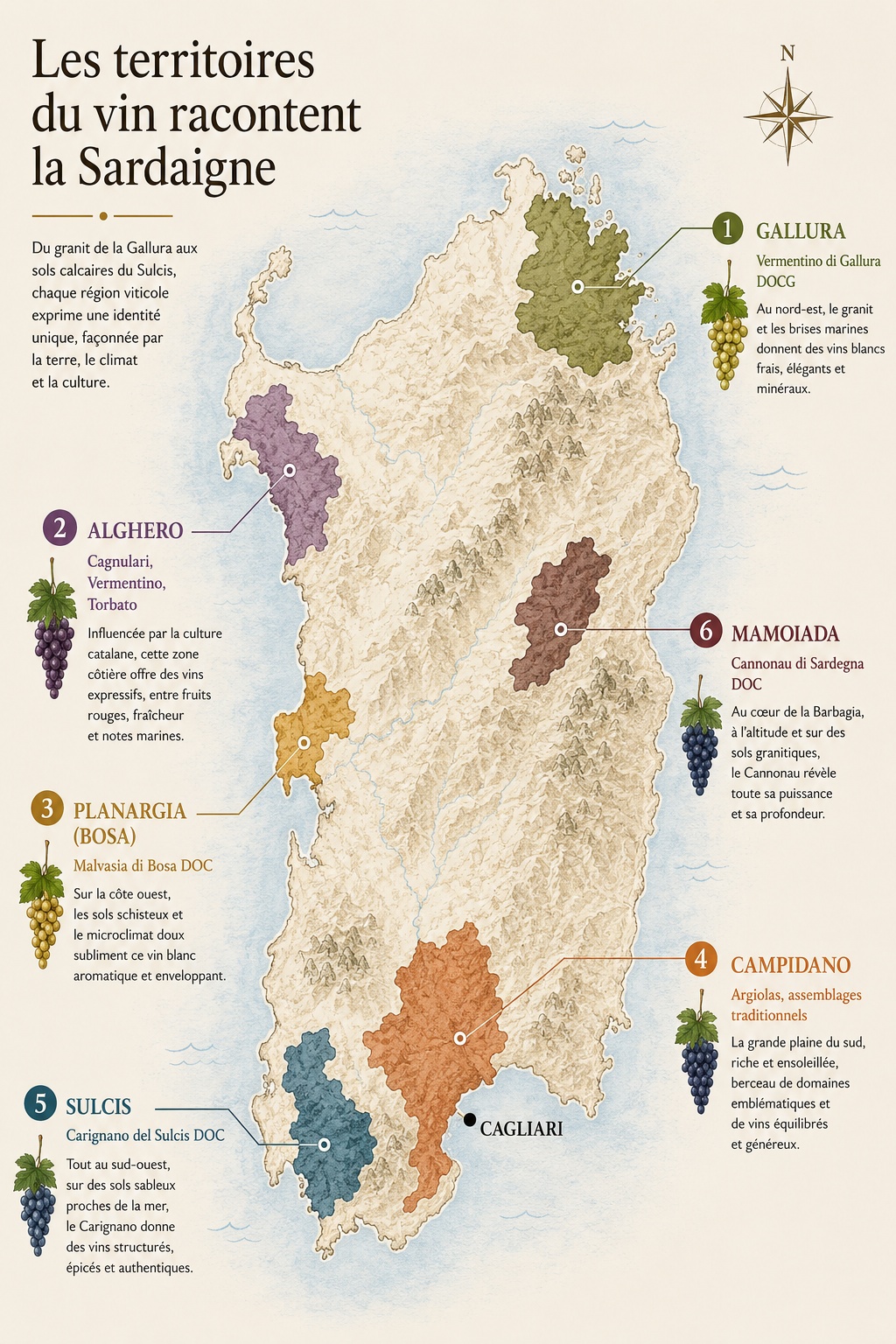
Cannonau is probably the most widely known. Closely associated with the Barbagia — the mountainous interior of the island — it has long accompanied the image of an inward-looking Sardinia: discreet, rural, and deeply attached to its traditions. The villages of Mamoiada, Oliena, or Orgosolo bear little resemblance to the coastal resorts. The pace of life is different. So are the landscapes, and the people.
This is also the region that has attracted international attention through longevity research. Cannonau is sometimes cited in these studies — not as a miracle explanation, but as one of many elements of a way of life that combines physical activity, a Mediterranean diet, strong social cohesion, and deep territorial roots.
At the other end of the island, Vermentino tells a very different story.
Dominant in northern Sardinia — and particularly in Gallura — it has become one of the most identifiable expressions of its territory. Here, granite hills give way to valleys open to the sea. The wind is constant. Soils are often poor and stony. Light is intense for much of the year.
Vermentino di Gallura is today the only DOCG appellation in Sardinia, a recognition granted in 1996. Understanding Gallura without understanding the influence of granite, sea breezes, and the region’s particular geography is difficult.
Gallura has also become, over the decades, one of the most internationally oriented territories on the island. Many foreign buyers first discover Sardinia through Porto Cervo, Porto Rotondo, Palau, or Santa Teresa Gallura. Yet behind those coastal landscapes lies a hinterland that has preserved a strong agricultural identity — one in which Vermentino is among the most visible expressions.
Further south-west, in the Sulcis, Carignano offers another reading of the territory.
Some vines here have been cultivated for generations using the traditional alberello method — a low-trained form adapted to the powerful winds that cross this part of the island. In several areas close to the sea, the vines grow directly in sandy soils. This particular feature allowed certain plots to escape the phylloxera blight that destroyed most of Europe’s vineyards in the late nineteenth century.
The interest of Carignano lies not only in its flavour profile. It speaks above all to the way a community adapted its farming practices to the constraints of its environment. Here too, the wine says more about a territory than about a product.
Other varieties — Bovale, Nuragus, Malvasia di Bosa — serve as a reminder that Sardinia cannot be reduced to a handful of flagship appellations. Each valley, each farming area, each community has often preserved part of its own viticultural heritage. That diversity is as much a cultural richness as it is a landscape one.
When climate speaks through the glass
Visitors are sometimes surprised by the intensity of certain Sardinian wines. Alcohol levels frequently exceed 14%, particularly for Cannonau.
This is not the result of any deliberate pursuit of concentration in the winery. It follows directly from the island’s natural conditions: significant sunshine, long dry summers, often poor soils, and relatively limited yields. Grapes reach high levels of ripeness that translate naturally into fuller, more structured wines.
But this climatic reality extends well beyond wine. The same factors shape traditional architecture, the organisation of agricultural life, the rhythm of summer days, and even the way villages developed over time.
Sardinian wines are simply one of its most tangible expressions.
A few reference points on the map
A handful of estates help locate the island’s main wine-producing regions — without any intention here of ranking or recommending.
In the south, around Serdiana, Argiolas has accompanied the development of the Campidano vineyard for several generations. Its history is closely tied to the emergence of modern viticulture in this part of Sardinia, through varieties such as Bovale Sardo and Nuragus that define the agricultural identity of the south.
In Alghero, Sella & Mosca is one of the main reference points for the north-west. Founded in 1899, the estate reflects another facet of the island — one marked by Catalan historical influence and landscapes very different from those of Gallura or Barbagia. Its Vermentino and Torbato — a variety of Spanish origin that has become nearly exclusive to this area — anchor it firmly in a particular geography.
Further south-west, Cantina di Santadi illustrates the importance of Carignano in the Sulcis and the continuing role of cooperatives in certain rural Sardinian communities. Founded in 1960, it represents what collective winemaking can produce when it draws on a terroir as singular as these ungrafted vines trained in alberello on sandy soils.
A wine culture that contributes to quality of life
For someone settling in Sardinia, the presence of wine rarely takes the form of a sophisticated oenological experience. It appears instead in everyday life. At village markets. At family meals. At local festivals. In conversations between neighbours. At the small family-run cantine where people come to pick up a few bottles for the week.
This proximity often surprises newcomers.
Across much of Europe, wine has become a product distributed largely through commercial networks. In Sardinia, it retains a local, relational dimension. Many residents know a producer personally — a neighbour, a cousin, someone nearby who tends a few rows of vines.
That dimension takes on a different meaning when observed from the outside. As a member of the Association of Sardinians in Quebec in Montreal, I took part in organising a tasting of Sardinian products — wines and spirits — that included the Vernaccia di Oristano produced by the Carta family. Sharing that wine in Montreal, explaining where it comes from, what territory it represents, and which family has been producing it for generations — that experience made clear how far Sardinian wine culture extends beyond the question of wine itself.
It travels with those who leave the island. It remains recognisable precisely because it is so deeply rooted.
That reality contributes to the quality of life that many international buyers are looking for when they choose to spend more time in Sardinia — not because wine is central to their project, but because it reveals a broader way of inhabiting a territory: with greater proximity, seasonality, and continuity between daily life and the local environment.
Understanding the territory first
Sardinian vineyards tell a story of grape varieties, soils, and agricultural traditions. More than that, they tell the human geography of the island.
Gallura, Barbagia, Sulcis, and Campidano each have their own landscapes, rhythms, and identities. The vines are simply one of the more visible expressions of those differences.
That is perhaps why they offer a useful reading tool for those seeking to understand Sardinia beyond postcards or summer stays.
Before choosing a village or committing to a project, observing where the vines grow often helps to perceive what makes each territory singular — not through what it shows visitors, but through what it has been cultivating for generations.
This table makes no claim to being exhaustive. It extends the reference points covered in the article — a few grape varieties, a few regions, a few names — for those who wish to keep a visual record of Sardinia’s viticultural diversity.
This list of grape varieties is not exhaustive. It serves as a starting point for identifying the island’s major wine-growing regions.
| Grape variety | Main area | Colour | Key characteristic | Producer cited |
|---|---|---|---|---|
| Cannonau | Barbagia, centre | Red | Associated with the mountainous interior and local longevity traditions | Giovanni Montisci (Mamoiada) |
| Vermentino | Gallura, north | White | Sardinia’s only DOCG, linked to granite soils and sea winds | Siddùra |
| Carignano | Sulcis, south-west | Red | Alberello vines, some ungrafted on sand | Cantina di Santadi |
| Bovale | Centre and south | Red | Traditional variety, reflects Sardinia’s viticultural diversity | Argiolas (Serdiana) |
| Nuragus | Centre-south | White | One of the island’s oldest white grape varieties | Argiolas (Serdiana) |
| Malvasia di Bosa | Bosa area, west coast | White | Rare historical appellation tied to a very specific territory, oxidative style | Cantina Columbu |